The households with least to give are the ones giving the largest share away
The American Bible Society published the eighth chapter of its State of the Bible USA 2026 on 11 November, under the title When Love Abounds, So Does Generosity. It sets two things beside each other: how people love, and how they give.
The movement in the headline figure is small. Sixty-four per cent of Americans gave to a charity during 2024. Last year it slipped, in the chapter's own words, to "a slight dip to 62 percent". Giving fell sharply in 2020 and 2021 and picked up again in 2022, so what the run of years shows is a number that moves a few points either way, not a collapse.
Do people who read the Bible give more?
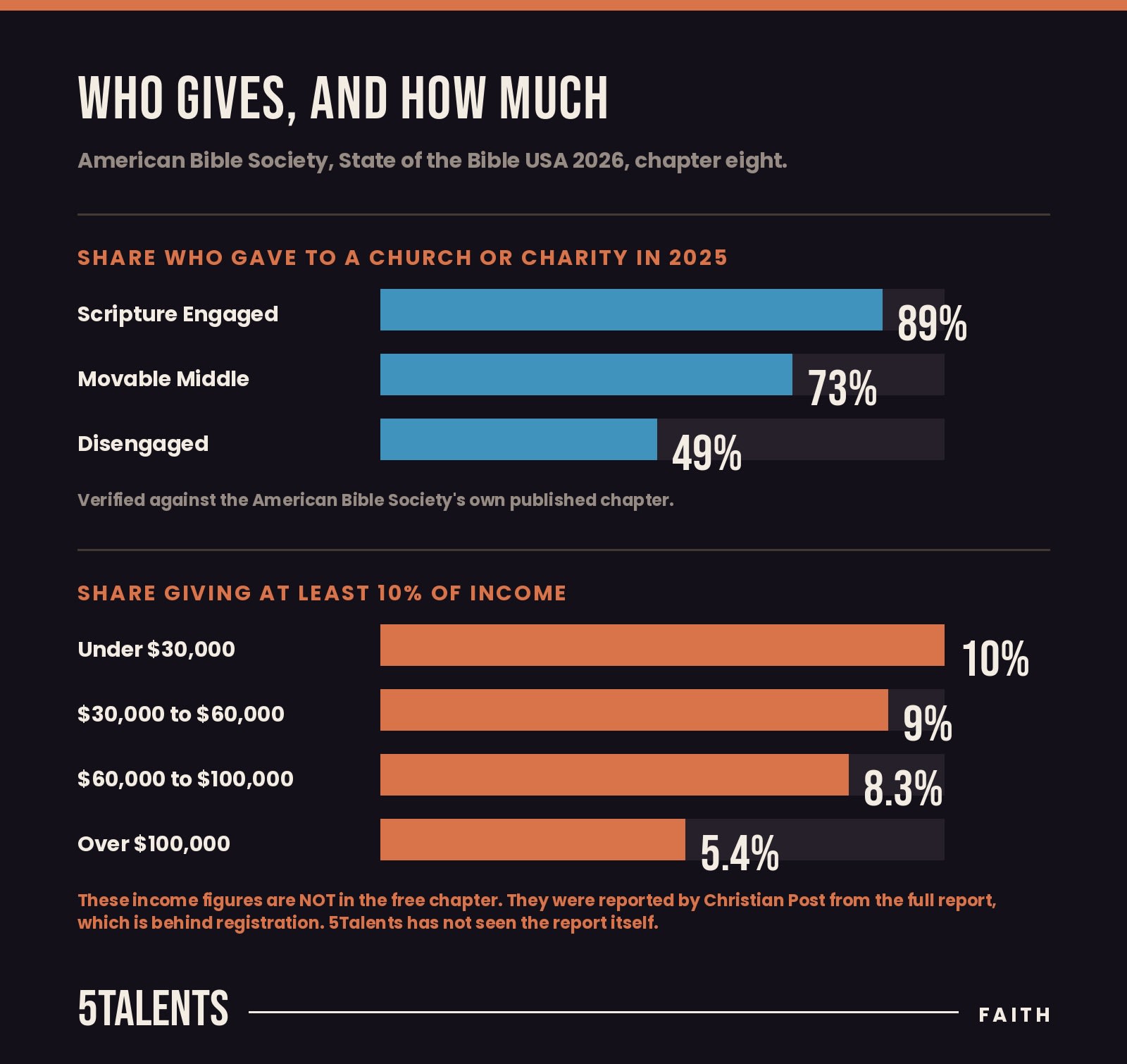
Markedly. Among those the study calls Scripture Engaged, 89 per cent gave to a church or a charity in 2025. Among the Movable Middle it was 73 per cent, and among the Disengaged 49 per cent — a forty-point spread between the top group and the bottom one.
The gap widens when the question moves from whether to how much. People who agree strongly that the Bible has transformed their life report a median donation of $1,000. Those who only agree somewhat report $200. Same question, same scale, five times the money.
Which households give the largest share of what they have?
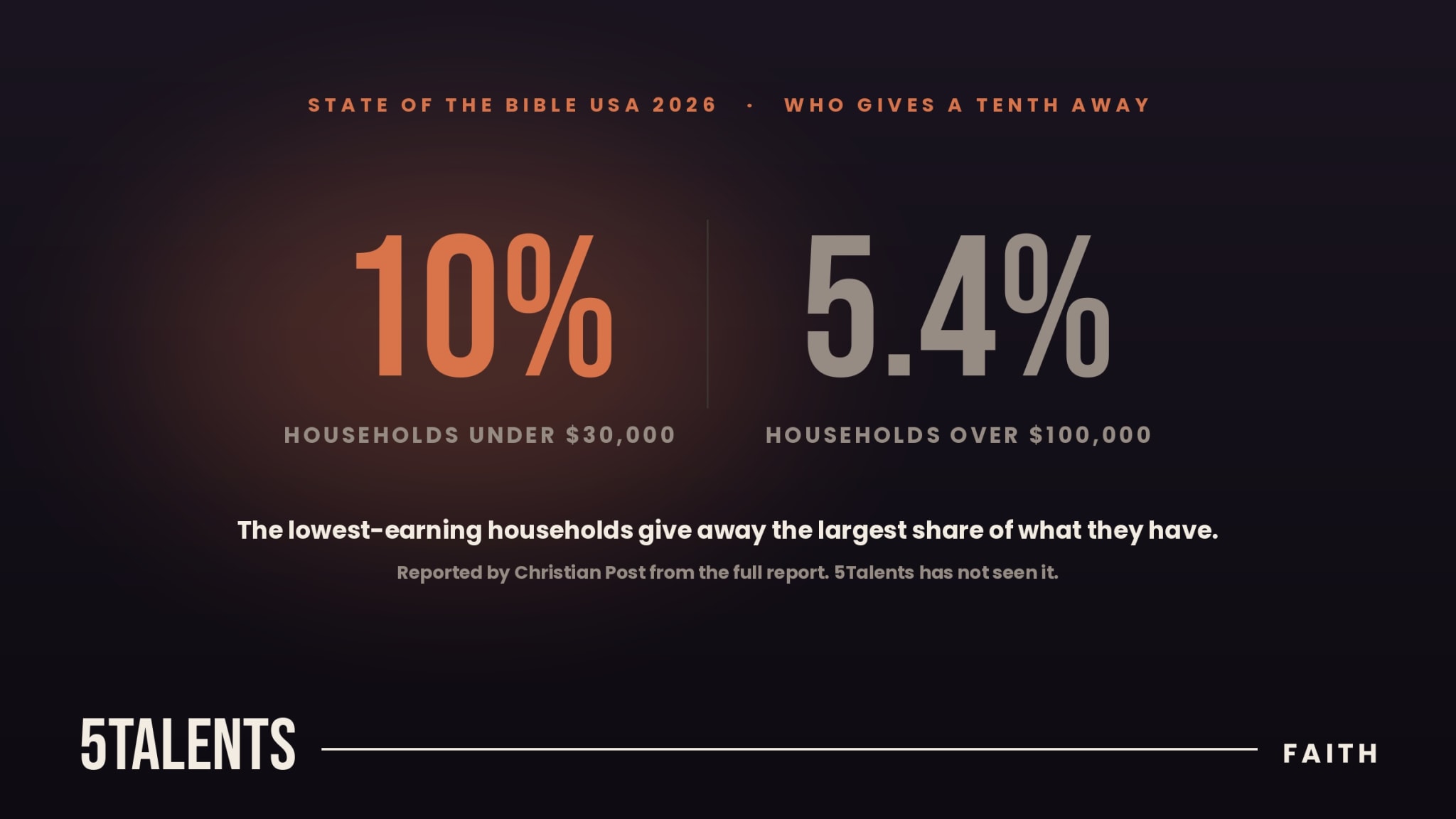
This is the finding that has travelled furthest, and it is also the one we cannot stand behind ourselves. Christian Post, reporting from the full study, says households earning under $30,000 are the likeliest to give away at least a tenth of their income — 10 per cent of them do. The figure falls as income rises: 9 per cent between $30,000 and $60,000, 8.3 per cent between $60,000 and $100,000, and 5.4 per cent above $100,000.
A note on where that comes from. Those numbers are not in the chapter the American Bible Society has published openly, which does not break giving down by income at all. The section that would hold them, called How much people are giving, sits inside the full report, and the full report is behind a registration wall. So read the income figures as Christian Post's account of a document we have not read. Everything else here comes from the chapter the Society has put out in the open, and we have checked it line by line.
Where does the money go?
About half of what donors give goes to their church, parish or temple. The rest goes to charities that are not religious, with local causes taking slightly more than national ones.
What is Contributory Love?
A measure the Society borrowed from Harvard's Human Flourishing Program. It rests on two statements a respondent agrees with or does not: "I make necessary sacrifices in order to help other people", and "My own well-being depends on meaningfully contributing to the well-being of others".
Of those who score high on it, 69 per cent made at least one donation last year. They also rate 7.2 or 7.3 out of ten on the Human Flourishing Index, about a point above those who say they rarely or never think that way. And the chapter notes that Contributory Love runs highest among the Scripture Engaged, which closes the circle the study is drawing: the people who read give, and the people who give flourish.
What this does, and does not, tell us here
It is an American survey of American adults, and there is no point pretending otherwise. No comparable Indian dataset exists. Nobody has put these questions to Indian Christians at this scale and published the answers, so there is nothing here to measure ourselves against, and anyone who tells you the percentages carry over is guessing.
What survives translation is the shape of the finding rather than its numbers. Giving tracks conviction more closely than it tracks income; and the people with least to spare are often the ones who part with the largest share of it. Anyone who has counted a Sunday offering in a small congregation will recognise the second half of that without needing a survey to confirm it.
Questions people are asking
What is the State of the Bible? The American Bible Society's annual research series on Bible reading and belief in the United States. The 2026 edition is released chapter by chapter; chapter eight, on love and generosity, came out on 11 November 2026.
How many Americans gave to charity last year? 62 per cent in 2025, down slightly from 64 per cent in 2024.
Do Bible readers give more than other people? On these figures, yes. 89 per cent of the Scripture Engaged gave in 2025, against 73 per cent of the Movable Middle and 49 per cent of the Disengaged.
How much do people actually give? The published chapter gives a median of $1,000 for those who agree strongly that the Bible transformed their life, and $200 for those who agree only somewhat. Christian Post reports an overall median gift of $500, a figure that is not in the free chapter.
Which income group gives away the biggest share? On Christian Post's reading of the full report, households under $30,000: ten per cent of them give at least a tenth of their income, against 5.4 per cent of households above $100,000. These figures are not in the chapter the Society has published openly, and we have not seen the full report.
Where does the money go? About half of donors' giving goes to a church, parish or temple; the rest to non-religious charities, local ones slightly ahead of national.
What is Contributory Love? A two-statement measure taken from Harvard's Human Flourishing Program, about sacrificing for others and about your own wellbeing depending on contributing to theirs. Sixty-nine per cent of those scoring high on it gave at least once last year.
Is there anything like this for India? Not that we have found. No study has asked Indian Christians these questions at this scale and published the results, so the American percentages should not be read across.
Can I read it myself? The chapter is free to read at sotb.americanbible.org. The full report, which holds the income breakdown, requires you to register an account first.
Sources
- State of the Bible USA 2026, chapter 8: When Love Abounds, So Does Generosity (11 November 2026), American Bible Society
- Low-income households more likely to give at least 10% of their earnings to churches, charities: study, The Christian Post
- State of the Bible USA 2026 — full report (registration required), American Bible Society

Premasis Satman
Founder and Executive Director of 5Talents Magazine, writing from Hyderabad. He has written the magazine's editorial column since the first issue in July 2012.